Hoverfly
Syrphidae · Flies
Hoverfly on great blue lobelia
Brooklyn Botanic Garden, 19 August 2026
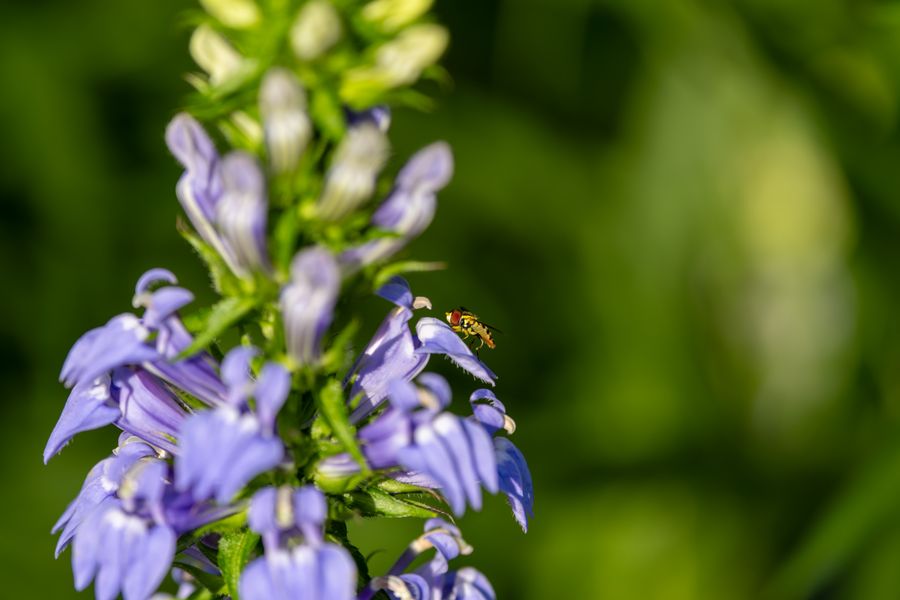
A hoverfly on great blue lobelia in the August border, a native relative of cardinal flower that swaps the hummingbird-red tube for cool blue-violet and, unlike its red cousin, is happy to be worked by bees and other short-tongued visitors. It is a plant of wet meadows across the East.
Small, with a narrow yellow-and-black abdomen: probably one of the Toxomerus flower flies, the commonest of the tiny hoverflies in the garden, wasp-patterned for protection it doesn't actually need.
Hover fly on coneflower
Brooklyn Botanic Garden, 12 July 2026
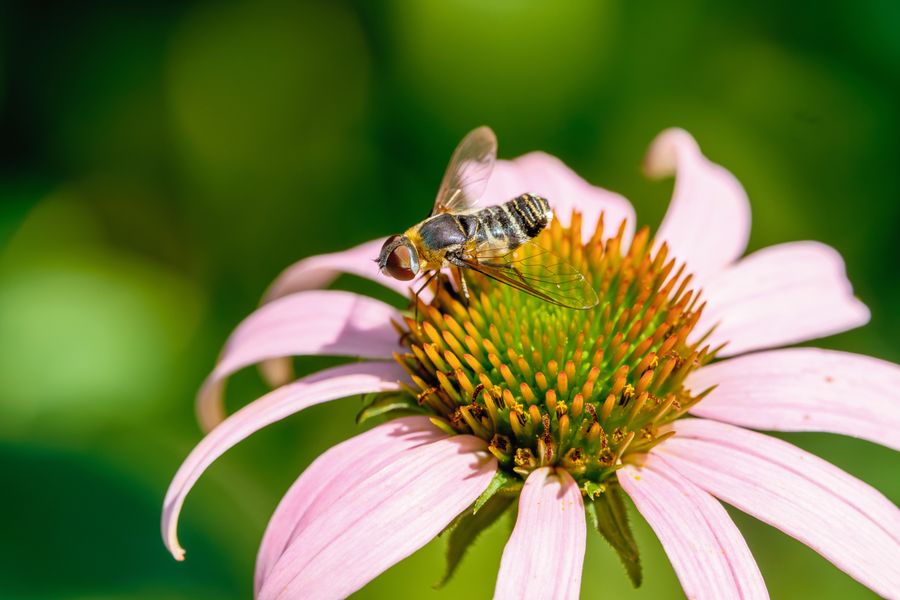
A hover fly on a coneflower in the July border, one of the drone flies, Eristalis, that mimic honeybees in gardens across the world - though I'd want a clearer view of the wing veins to be sure of the genus.
Big touching compound eyes and short stubby antennae rather than a bee's longer ones are the giveaway that this is a fly, despite the yellow-and-black doing its best to suggest otherwise. The mimicry is purely visual: the flight itself, all sudden stops and hovering, looks nothing like a bee's.
Hoverfly in flight
Brooklyn Botanic Garden, 21 July 2024
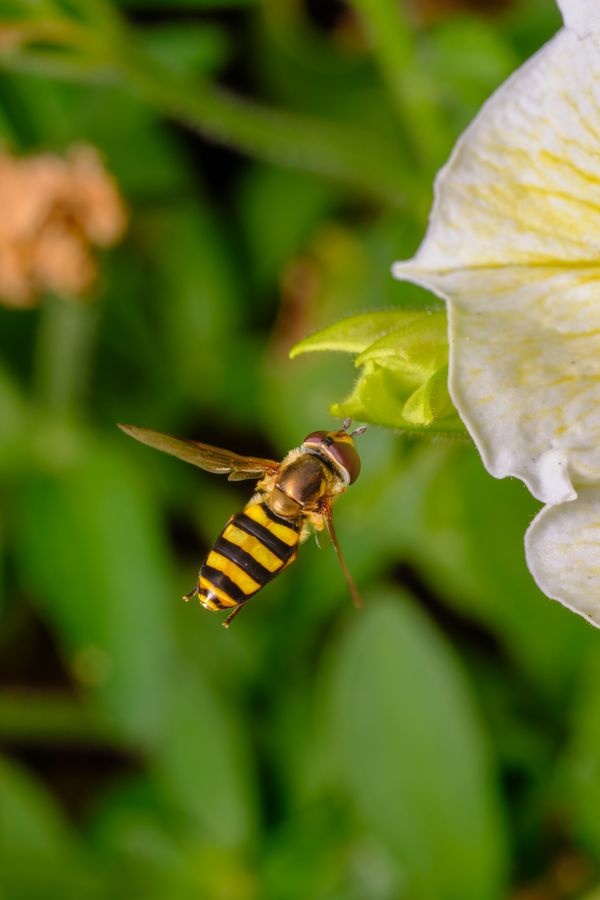
A hoverfly caught airborne beside a petunia in the July border, wings blurred enough to show the hover this family is named for: holding position in the air rather than committing to a direction. Hoverflies are garden flies of every continent, and the aphid-eating ones are among the most useful insects a border has.
The huge eyes meeting at the top of the head mark a male; a female's are separated. Wasp-striped for protection it doesn't need, since hoverflies have no sting and the colouring is borrowed. The adults feed on nectar and pollen and the larvae of many species eat aphids.
Hoverfly on a petunia
Brooklyn Botanic Garden, 21 July 2024
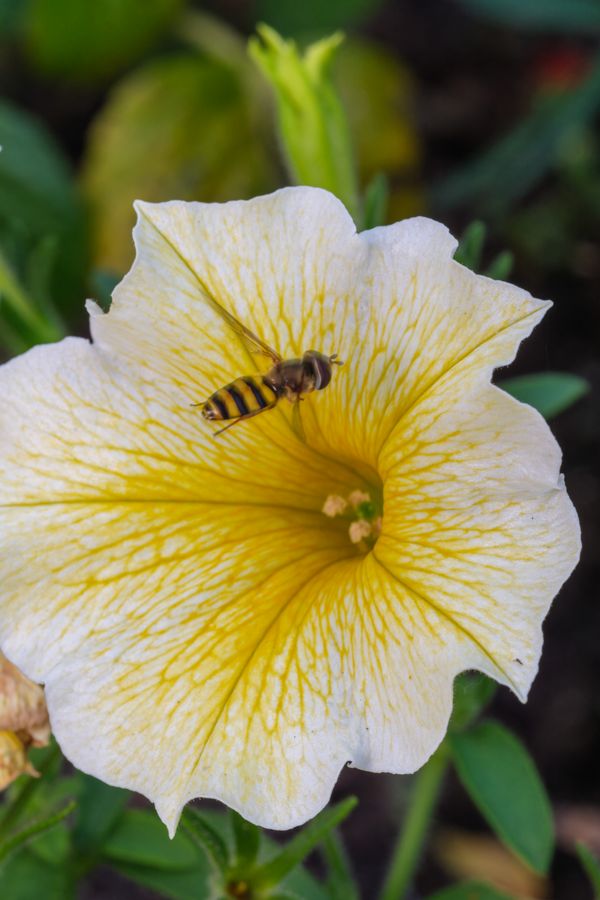
A hoverfly working the yellow-veined throat of a petunia in the July border. Hoverflies are flies of gardens and hedgerows everywhere, feeding on nectar and pollen as adults, and a summer border in Brooklyn holds a dozen species at once.
Wasp-striped for protection it doesn't need, since it has no sting, and told from a wasp at a glance by the single pair of wings, the short antennae and the way it holds still in the air. The veining on the petal isn't decoration for our benefit: it is a nectar guide, a set of lines converging on the centre of the flower that many insects see far more strongly than we do.
Birds, insects, plants and other wildlife, mostly from Brooklyn, with some from further afield.
Every photograph comes with notes on what it is.
Selected
Favourite shots. Filter by subject, or .
Places
Everything, by where it was taken.
Species
Larger catalogue of photos organized by species of animal or plant.
Catalogue
Every photograph, newest first. Narrow it by period, place or species; the three work together.
Updates
Coming soon. Sign up at the bottom of the page for updates.