Hummingbird Clearwing Moth
Hemaris thysbe · Moths
Hummingbird Clearwing Moth, tail fanned
Brooklyn Botanic Garden, 24 August 2025
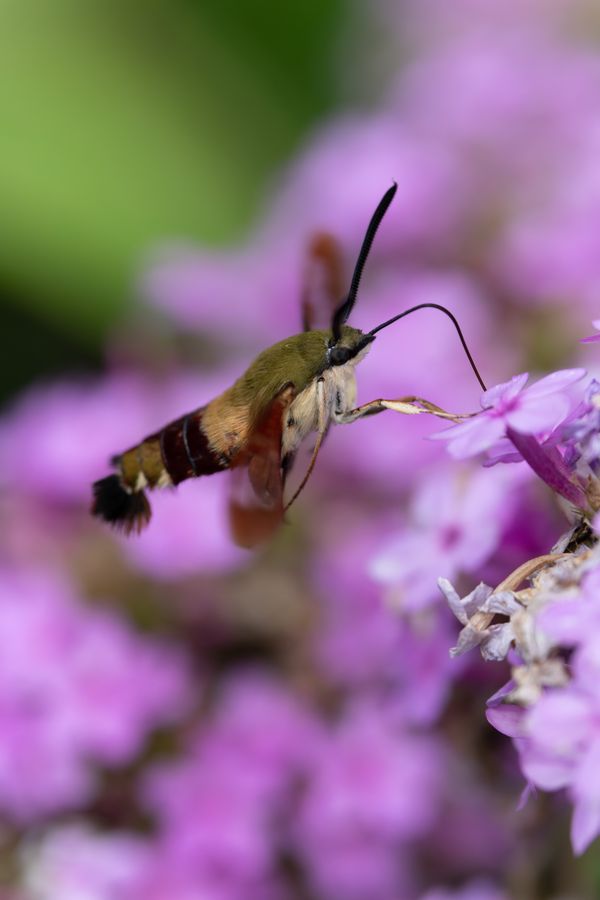
A Hummingbird Clearwing hovering at a flower in the August border, the black tail tufts fanned wide. A day-flying hawkmoth of the eastern woods and gardens, and the moth behind most reports of tiny hummingbirds across the eastern United States.
The tail is used for stability in the hover, the way a hummingbird uses its tail, though this is an insect and the "feathers" are scales. The clear patches in the wings are where the scales fall off on the first flight, leaving bare membrane; a freshly emerged one has fully coloured wings for a few minutes.
Hummingbird Clearwing Moth
Brooklyn Botanic Garden, 24 August 2025
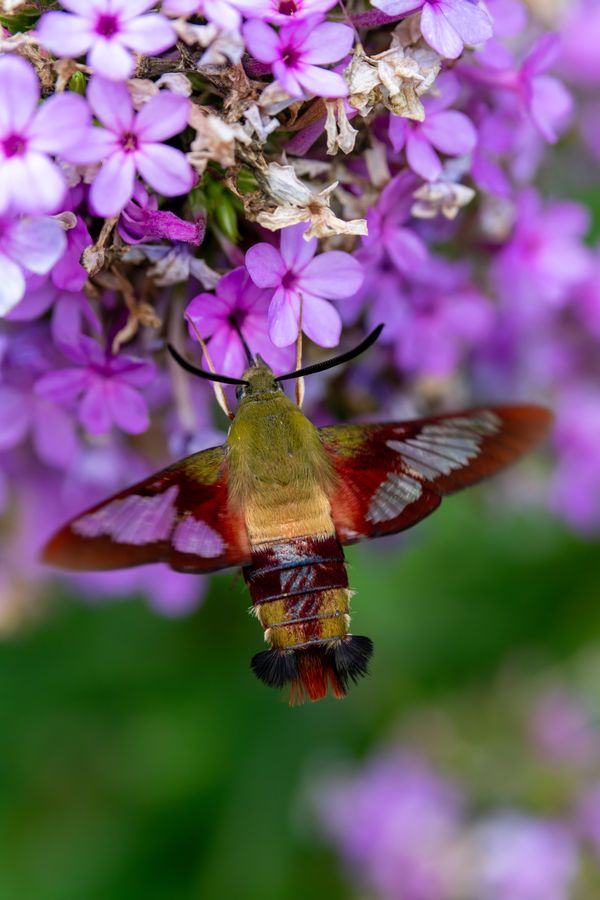
A Hummingbird Clearwing hovering at flowers in the August border, doing exactly what it is usually mistaken for. It is a hawkmoth of gardens and forest edges across eastern North America, flying by day, and the source of most reports of tiny hummingbirds in gardens across the region.
The giveaway is the clear, scale-free patches on the wings, absent on any actual hummingbird. The wings start out fully scaled like any other moth's; the scales rub off on the first flight, which is why the "clear wing" only appears after the moth has been flying for a day or two.
Hummingbird Clearwing Moth, hovering
Brooklyn Botanic Garden, 24 August 2025
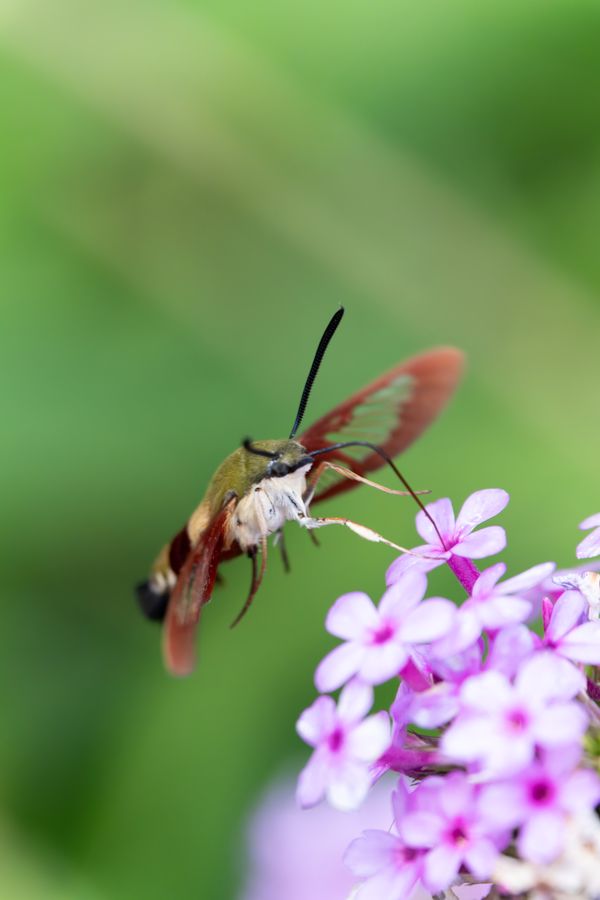
A Hummingbird Clearwing holding station in front of a flower head in the August border rather than landing on it. A day-flying hawkmoth of the eastern United States, out in full sun in gardens and at woodland edges, and mistaken for a hummingbird often enough to have been named for it.
Hovering this precise takes a wingbeat rate closer to a hummingbird's than to any other moth's, and the long tongue does the rest. The caterpillars feed on honeysuckle and viburnum.
Hummingbird Clearwing Moth, approaching
Brooklyn Botanic Garden, 24 August 2025
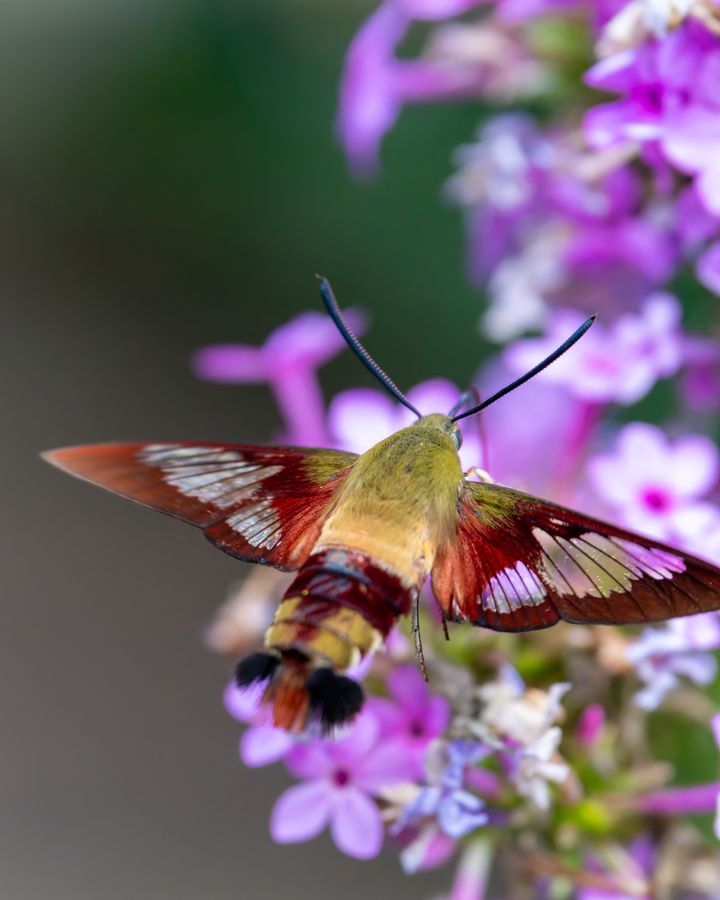
A Hummingbird Clearwing coming in to a phlox head in the August border, wings blurred with speed and the long proboscis already uncurling ahead of the body. It is a day-flying hawkmoth of gardens and woodland edge across the eastern United States, and a phlox bed in late summer is where it feeds.
Close enough in size, colour and flight style to a hummingbird that most people's first reaction on seeing one is to double-check it is actually a moth. It is, and it flies by day in full sun, which very few hawkmoths do.
Birds, insects, plants and other wildlife, mostly from Brooklyn, with some from further afield.
Every photograph comes with notes on what it is.
Selected
Favourite shots. Filter by subject, or .
Places
Everything, by where it was taken.
Species
Larger catalogue of photos organized by species of animal or plant.
Catalogue
Every photograph, newest first. Narrow it by period, place or species; the three work together.
Updates
Coming soon. Sign up at the bottom of the page for updates.