Ruby-throated Hummingbird
Archilochus colubris · Hummingbirds
Ruby-throated Hummingbird, hovering
Brooklyn Botanic Garden, 19 August 2026
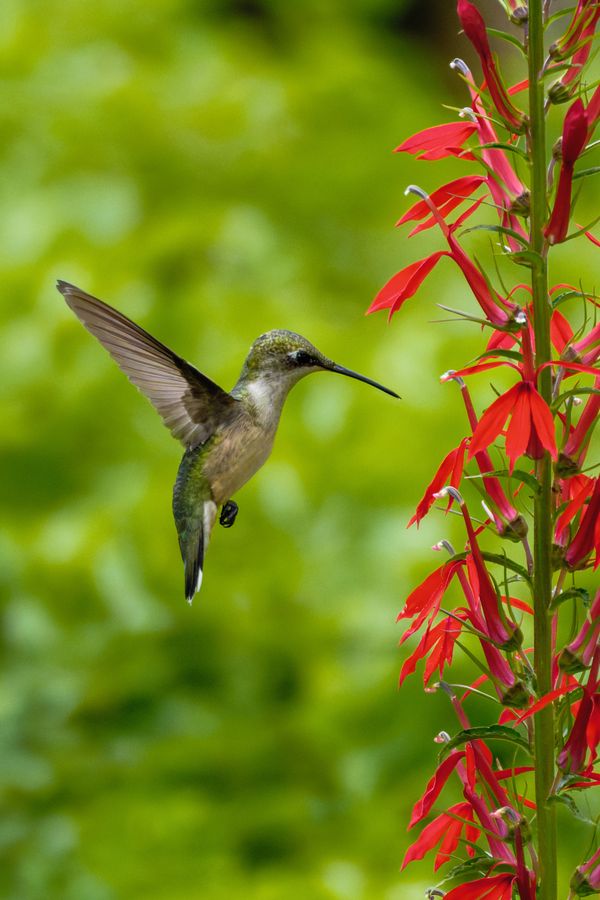
A female or immature Ruby-throated Hummingbird approaching a spike of cardinal flower head-on in the August border, tail fanned wide. It is the only hummingbird that breeds east of the Mississippi, a summer visitor to Brooklyn from Central America, and cardinal flower in August is what it lives on before the flight south.
The tail is fanned for stability rather than display; in a hover the tail is a rudder, and it opens and closes constantly as the bird corrects its position. Cardinal flower is built for this visitor: the long red tubes hold nectar out of reach of most insects and offer nothing to land on, so it is pollinated almost entirely by hummingbirds, which pick up pollen on the forehead as they feed. The wings are beating around fifty times a second.
Ruby-throated Hummingbird at cardinal flower
Brooklyn Botanic Garden, 13 August 2026
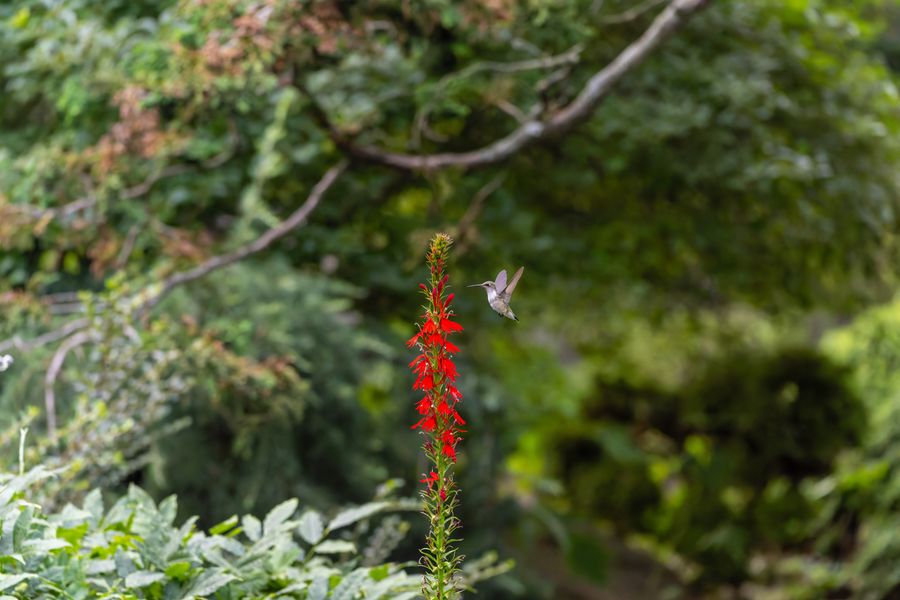
A Ruby-throated Hummingbird at cardinal flower in the August border, the only hummingbird that breeds in the East and a summer visitor to Brooklyn from Central America. Cardinal flower is a native of wet ground, and in August it is the plant the garden's hummingbirds live on.
No red throat visible: a female, or a young male still to come into his gorget. Cardinal flower's deep red, oddly shaped tube is built almost exclusively around this one pollinator. Bees generally can't manage the flower's shape or reach its nectar, and hummingbirds are the main reason it gets pollinated at all.
Ruby-throated Hummingbird at Cardinal Flower
Brooklyn Botanic Garden, 26 July 2026
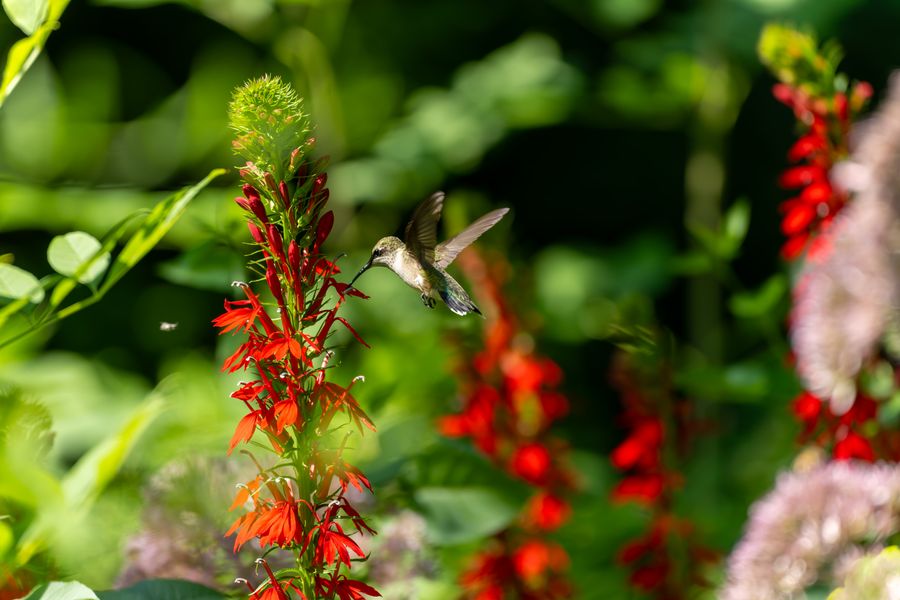
A Ruby-throated Hummingbird at Cardinal Flower in the July border, the only hummingbird that breeds east of the Mississippi and a summer visitor to Brooklyn from Central America. Cardinal Flower is a native of wet ground and stream edges across the East, and the two have shaped each other.
No red throat patch on this one, which makes it a female or an immature bird. Cardinal Flower is about as specialised for hummingbird pollination as an eastern wildflower gets: a long, narrow, brilliant red tube shaped to keep out short-tongued insects and reward exactly the bird pictured, which picks up pollen on its forehead as it feeds.
Hummingbird at jewelweed
Brooklyn Botanic Garden, 31 August 2025
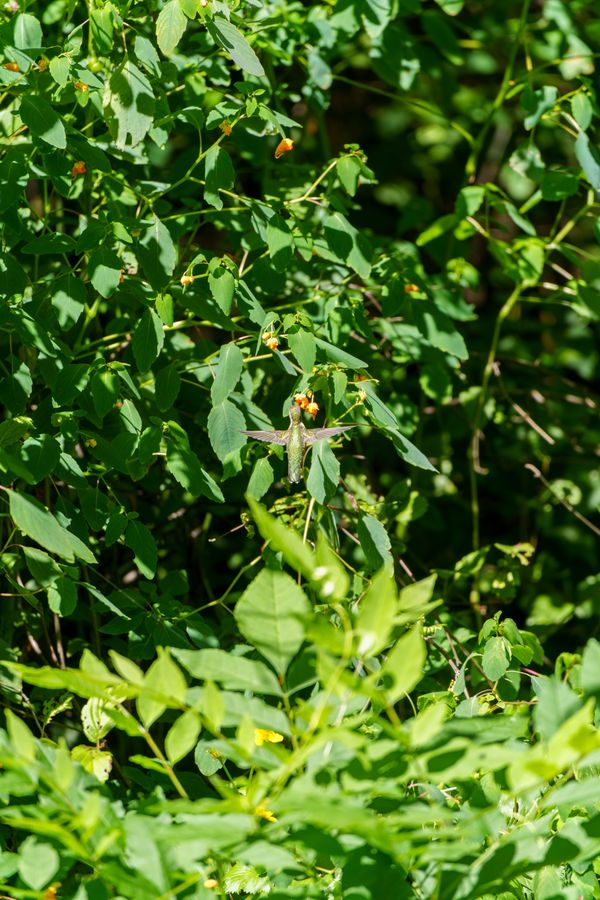
A Ruby-throated Hummingbird hovering into a stand of jewelweed at the Botanic Garden at the end of August, wings a full blur, on its way south. Jewelweed grows in damp shade across the eastern woods, and it is one of the hummingbird's staple flowers on the migration to Central America.
The orange, spotted, spurred flowers are also called spotted touch-me-not, for seed pods that snap open and fling their seeds at the slightest touch once ripe. The two have shaped each other: the flower's spur is exactly the length of the bird's bill.
Ruby-throated Hummingbird
Brooklyn Botanic Garden, 24 August 2025
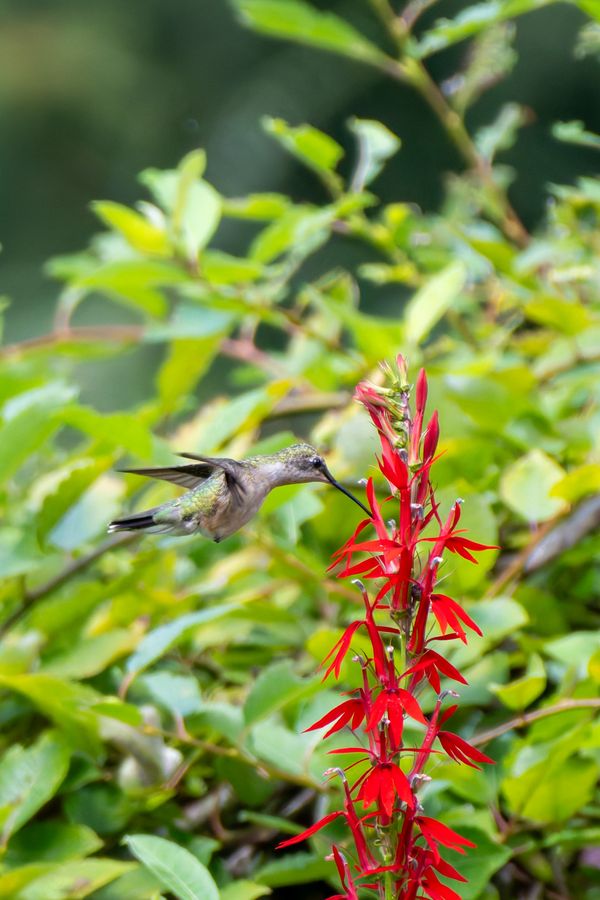
A Ruby-throated Hummingbird at cardinal flower in the August border, the only hummingbird that breeds east of the Mississippi and a summer visitor to Brooklyn from Central America. It is about to leave: by mid-September the Ruby-throats have gone, and many fly the Gulf of Mexico in a single night.
No red throat visible, so a female, or a young male still to come into his gorget. Cardinal flower is a native lobelia whose deep red tube is built almost exclusively around this one pollinator. Bees generally can't manage the flower's shape or reach its nectar; hummingbirds are the main reason it gets pollinated at all.
Birds, insects, plants and other wildlife, mostly from Brooklyn, with some from further afield.
Every photograph comes with notes on what it is.
Selected
Favourite shots. Filter by subject, or .
Places
Everything, by where it was taken.
Species
Larger catalogue of photos organized by species of animal or plant.
Catalogue
Every photograph, newest first. Narrow it by period, place or species; the three work together.
Updates
Coming soon. Sign up at the bottom of the page for updates.