Blue Morpho
Morpho peleides · Butterflies
Blue Morpho, underside
Carlsbad, 7 March 2026
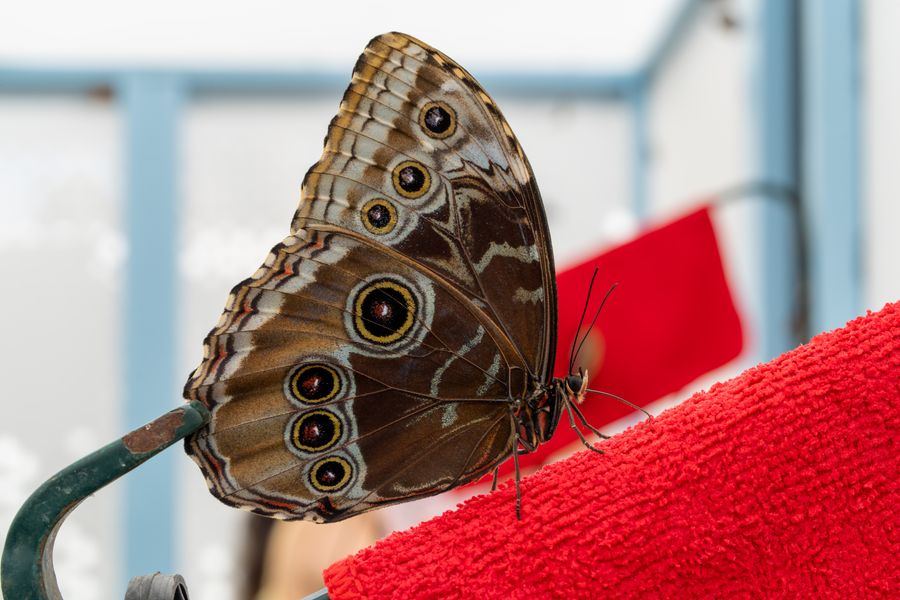
A Blue Morpho with the wings closed, in the butterfly house at Carlsbad. In the rainforests of Central and South America this is how it rests, on a trunk or a leaf in the understory, and how it stays alive.
The famous electric blue is entirely on the upper surface, gone the instant the wings close. What is left is this: a dead-leaf brown scattered with owl-like eyespots, each one a small deception aimed at a bird's instinct to avoid anything that looks like it is already looking back.
Blue Morpho wing, close
Fairchild Tropical Botanic Garden, 7 February 2026
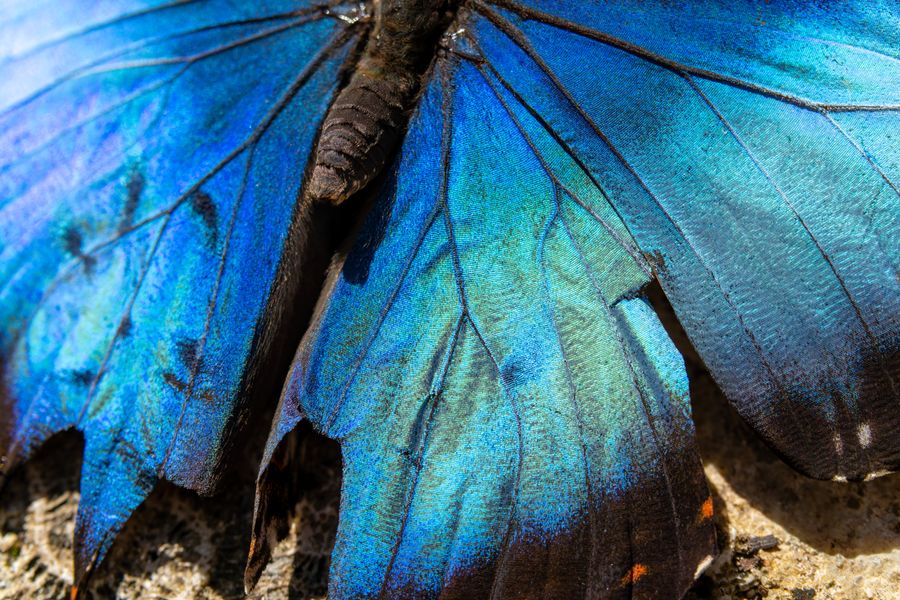
A Blue Morpho wing close enough to see the colour is not uniform, in the butterfly house at Fairchild. This is the great blue butterfly of the Central and South American rainforest, and the blue is built, not painted.
The colour comes in bands of slightly different blue and green along the wing veins. The underlying scale structure varies subtly across the wing, which is why the same species can look sapphire in one photograph and closer to turquoise in another taken moments apart. The scales are ridged like a roof, and the ridges are spaced at almost exactly the wavelength of blue light.
Blue Morpho on stone
Fairchild Tropical Botanic Garden, 7 February 2026
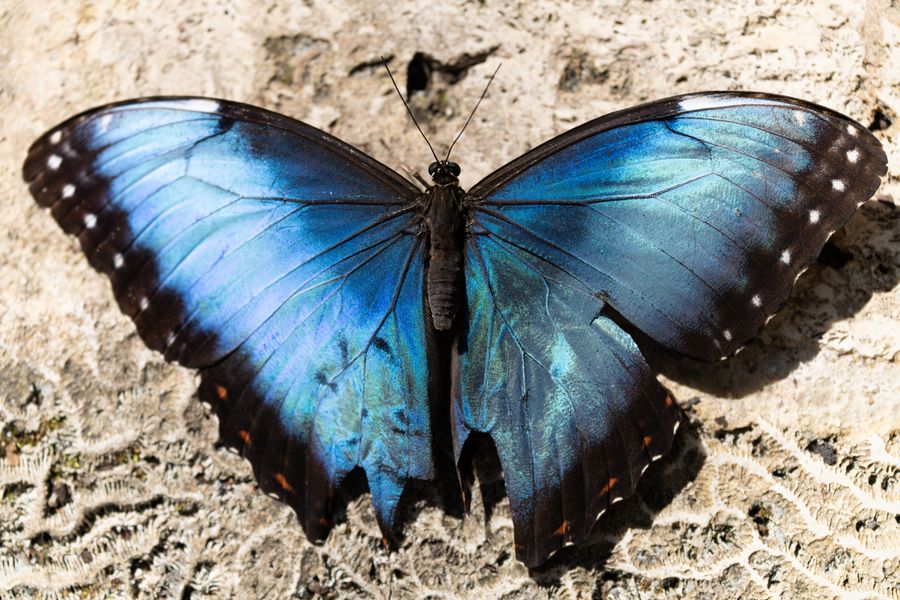
A Blue Morpho with wings fully open on a pale, lichen-crusted stone in the butterfly house at Fairchild, the blue reading almost electric against the muted background. In its native rainforest it glides low along streams and forest edges from Mexico to Brazil.
Morphos spend most of their time gliding with slow, deep wingbeats rather than fluttering, alternately flashing blue and vanishing as the dull brown underside shows on the upstroke - a strobe effect thought to make them harder for a bird to track in flight.
Blue Morpho, wings open
Fairchild Tropical Botanic Garden, 7 February 2026
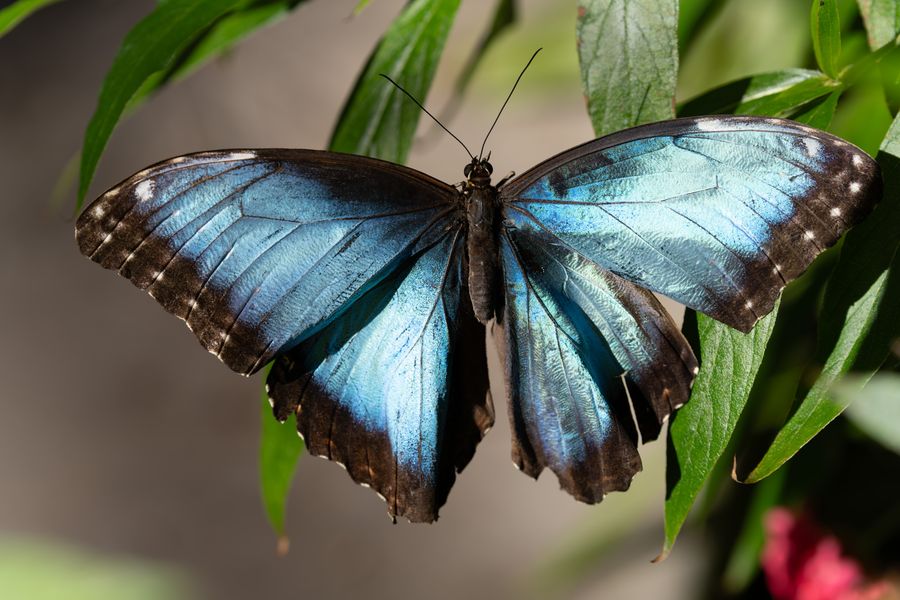
A Blue Morpho with its wings open in the butterfly house at Fairchild, a butterfly of the rainforests of Central and South America where it glides along the streams and clearings flashing exactly this blue.
The blue isn't pigment at all. The wing scales are colourless, but stacked in layers fine enough to interfere with light the way a soap film does, reflecting blue and cancelling out everything else. That is why the colour flashes rather than sitting still: it shifts with the angle of the light and the angle you view it from, which is exactly what a pigment can't do. Blue is the rarest colour in nature for the same reason - almost nothing makes a blue pigment, so the animals that look blue have to build it.
Blue Morpho, underside
Fairchild Tropical Botanic Garden, 7 February 2026
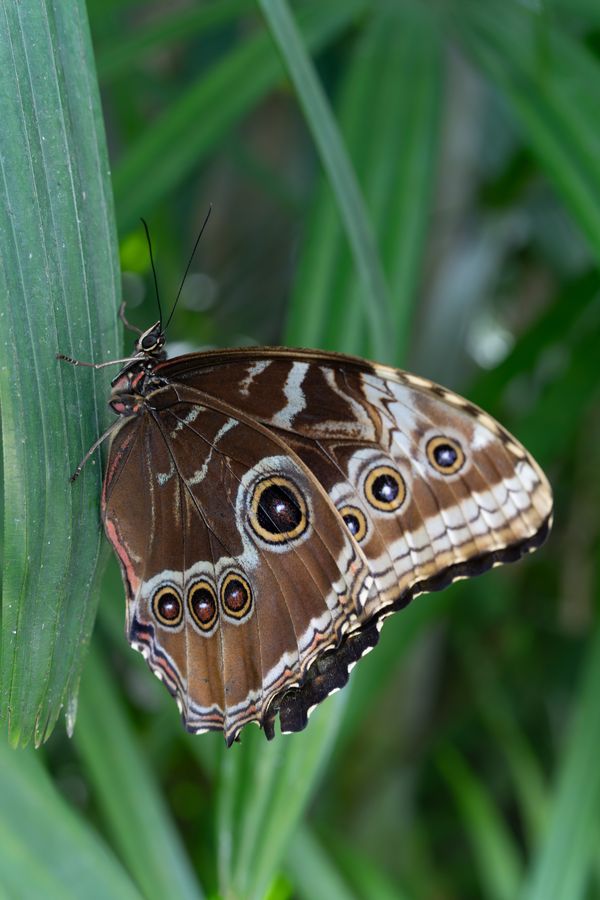
A Blue Morpho with its wings shut in the butterfly house at Fairchild - not an owl butterfly, which is what I first took it for. Morphos are butterflies of the rainforests of Central and South America, and closed like this is how they spend most of the day.
An owl butterfly carries one huge eyespot on the hindwing; a morpho carries a chain of smaller ones, ringed in yellow and rust, with pale bands between them. Closed, it gives away nothing of the blue it is named for. The underside is the resting disguise, and the eyespots are there to send a bird's first strike somewhere other than the body.
Blue Morpho, wings closed
Fairchild Tropical Botanic Garden, 7 February 2026
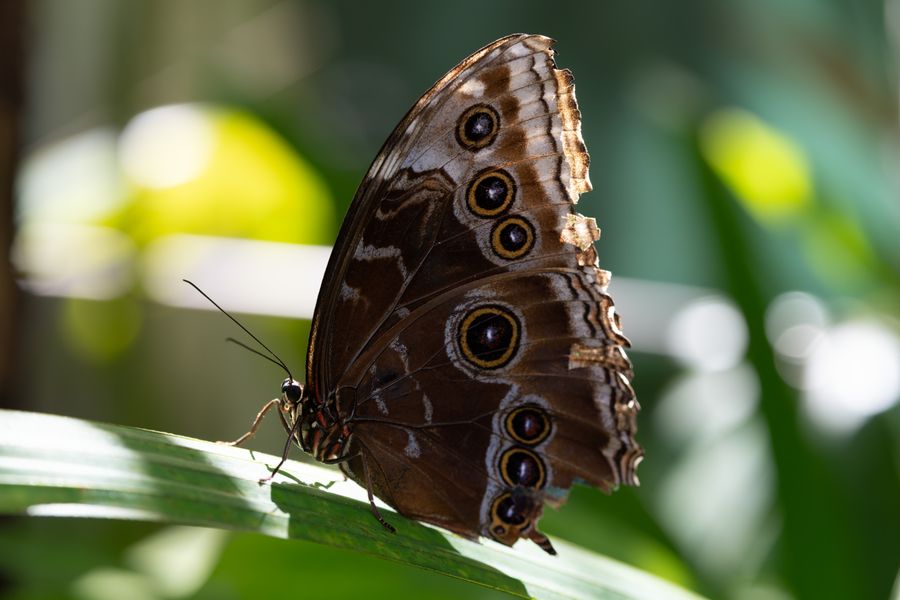
A Blue Morpho with its wings closed in the butterfly house at Fairchild. In the rainforests of Central and South America this is how it rests, on a trunk or a leaf in the understory, and how it stays alive.
Closed, a Blue Morpho gives away nothing of the colour it is named for - just this dead-leaf brown with a row of owl-like eyespots down each wing, meant to startle a bird that has already worked out where the insect is. The blue only exists in flight, or with the wings spread, which is presumably why almost every photograph of this species shows one or the other and so rarely both.
Birds, insects, plants and other wildlife, mostly from Brooklyn, with some from further afield.
Every photograph comes with notes on what it is.
Selected
Favourite shots. Filter by subject, or .
Places
Everything, by where it was taken.
Species
Larger catalogue of photos organized by species of animal or plant.
Catalogue
Every photograph, newest first. Narrow it by period, place or species; the three work together.
Updates
Coming soon. Sign up at the bottom of the page for updates.