Where they nest
Eight ways of building a home
A nest is not always a cup in a tree. Some of these dig, some borrow, some build in the water, and one builds a stack of sticks big enough to bring down a pole.
Purple Martin at the nest box
Staten Island, 5 July 2026
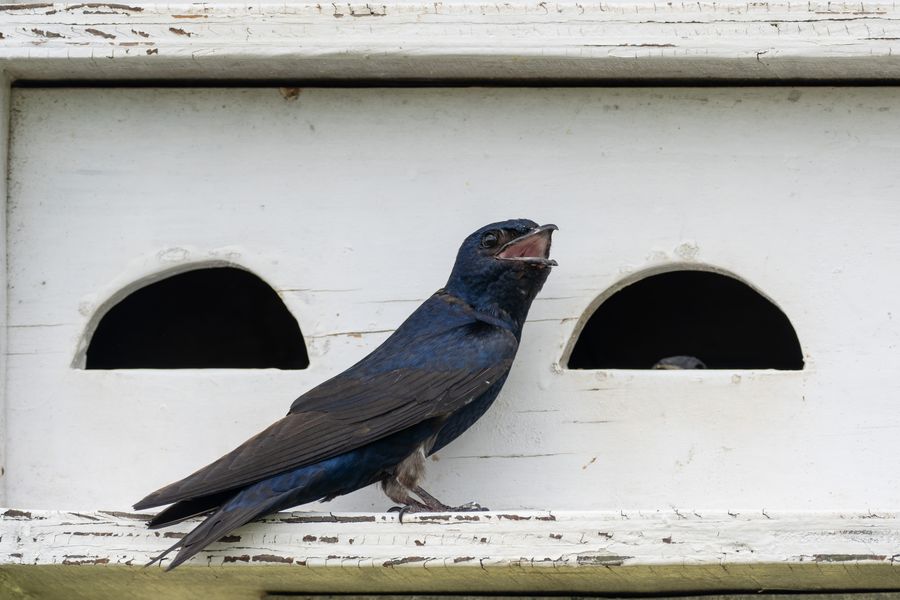
A Purple Martin calling from the threshold of a proper martin house on Staten Island, crescent-shaped entrance holes and all, with a neighbour visible in the next compartment. Martins are colonial nesters of open country near water, and in the East they live almost entirely in houses like this one.
They are famously site-faithful: the same colony, and often the same individual birds, return to a house year after year, which is why active martin housing tends to accumulate a following of dedicated landlords who track return dates each spring. The whole eastern population winters in the Amazon basin.
Bank Swallows in flight
Staten Island, 5 July 2026
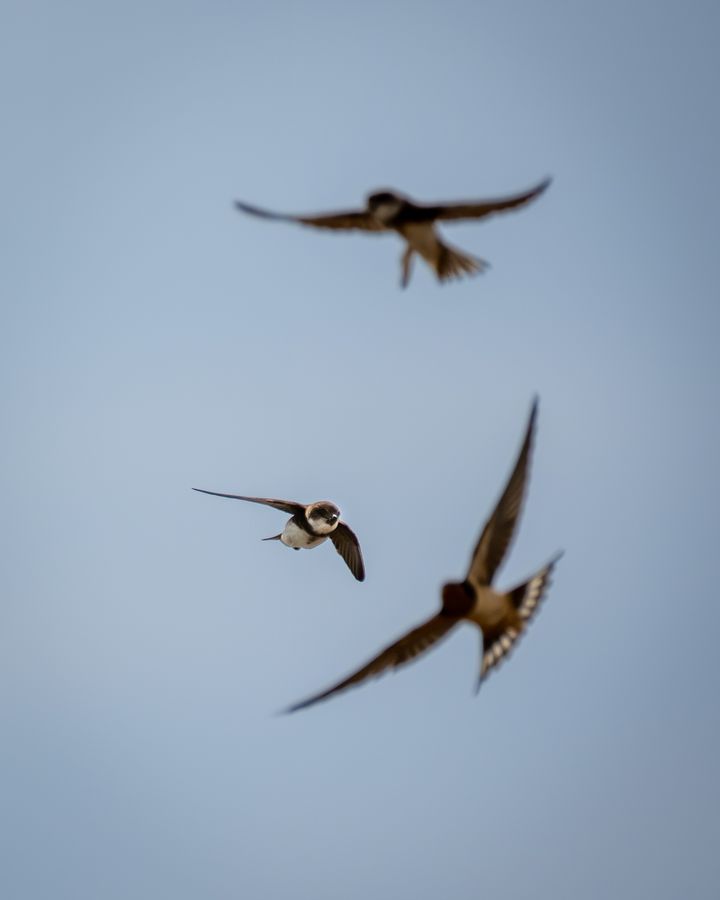
Two Bank Swallows over the marsh on Staten Island, the nearer bird's white throat and crisp brown breast band identifying it. Bank Swallows are the smallest swallow in North America and the only one that nests exclusively in burrows: tunnels up to a metre or more deep, dug into vertical faces of sand or soil, in colonies that can run to hundreds of pairs in a single bank.
The second bird, caught in a tighter turn, is almost certainly the same species, though the motion blur makes it a harder call. In Britain the same bird is the Sand Martin.
Belted Kingfisher, male
San Diego, 6 March 2026
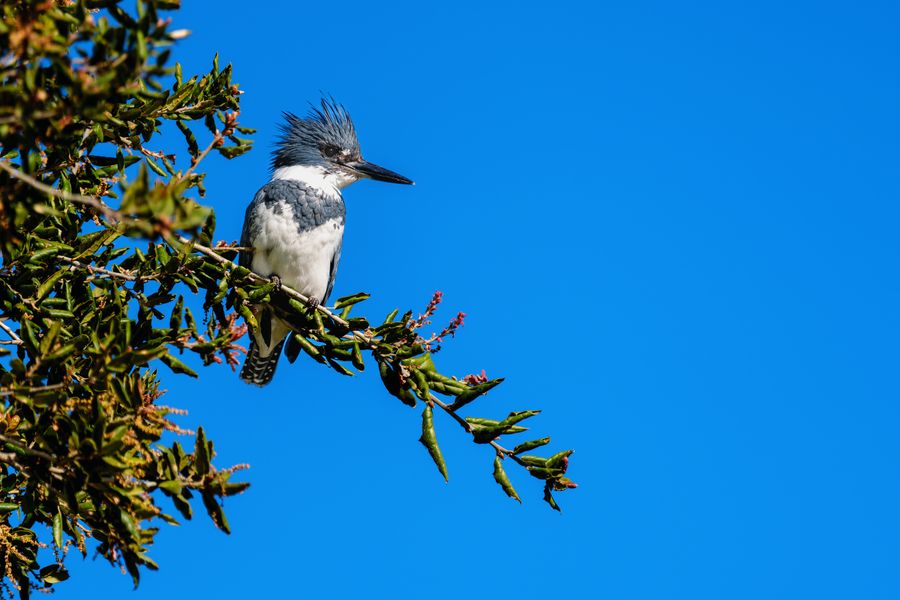
A male Belted Kingfisher on a perch over a San Diego pond, at the western edge of a range that covers nearly all of North America. Kingfishers need clear water to see fish in and a bank to dig a nest tunnel into, and a park pond with both will hold one all winter.
A shaggy blue-grey crest and a single grey breast band with no rufous below it: the plain white belly marks a male. Females carry a second, chestnut band across the flanks that males lack entirely, one of the few North American birds in which the female is the more boldly marked.
Osprey over Prospect Park
Prospect Park, 30 May 2026
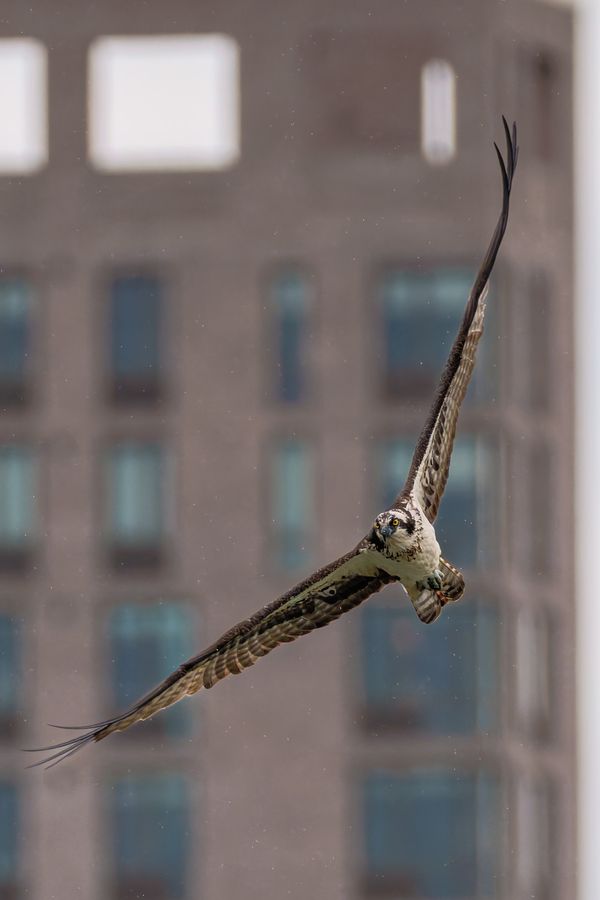
An Osprey banking hard against an apartment block on the edge of Prospect Park, nowhere near open water and simply passing overhead rather than hunting the neighbourhood. Ospreys eat almost nothing but fish, and the park's lake is too small and shallow to be much of a draw; the harbour is where this bird nests.
The bent, angular wings and dark wrist patches give the silhouette away at a distance, gull-like in a way a Red-tailed Hawk's never is. The feet are the real specialisation: a reversible outer toe lets an osprey grip a fish with two talons forward and two back, and spiny pads on the soles keep a wet, thrashing catch from sliding free.
Coot on the nest
Tenerife, 13 April 2026
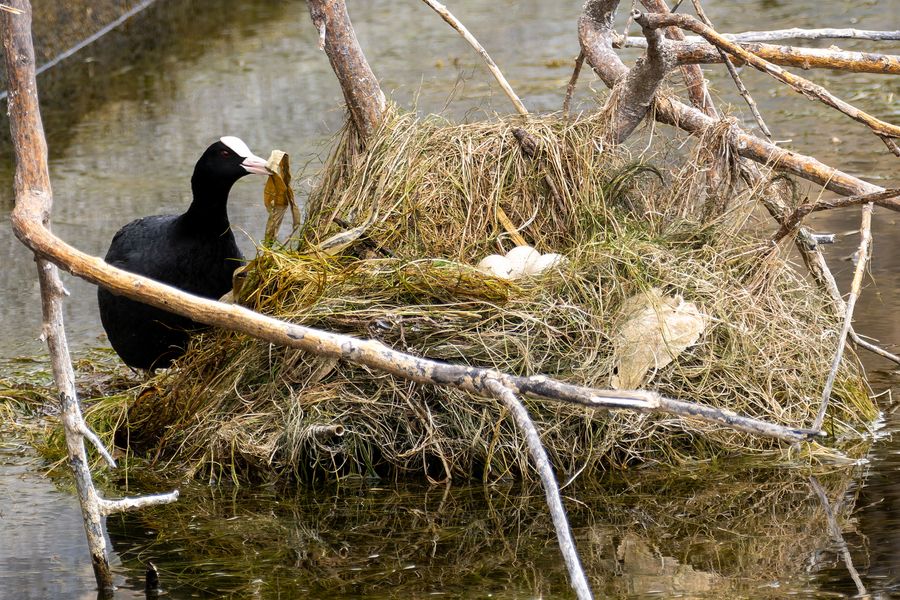
A coot on the nest on a pond in Tenerife, a platform of reed and grass piled up until it clears the waterline and added to constantly through incubation. Coots are birds of still fresh water across Europe and Asia, and on the Canaries they breed on the reservoirs and park ponds.
The scrap of plastic worked into this one is a measure of how little coots discriminate in nest material, provided it holds together. Both parents build and both incubate, taking turns so the nest, and the eggs on show here, are rarely left uncovered for long.
Monk Parakeet
Staten Island, 5 July 2026
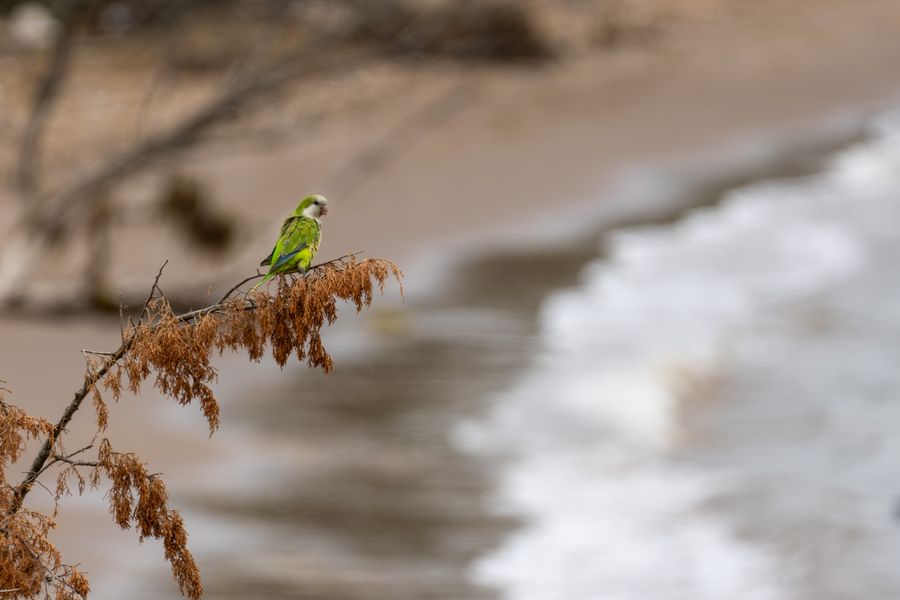
A Monk Parakeet on a dead branch on Staten Island, open water and a sandy shoreline behind it - a beach setting rather than the cemetery trees the city's colonies are usually associated with. Native to temperate South America, and established in feral colonies across parts of the United States, New York among them, from escaped cage birds in the 1960s and 70s.
Monk Parakeets are the only parrot that builds a stick nest rather than nesting in a cavity, and the nests are communal: one structure, added to year after year, can house dozens of pairs in separate chambers and get heavy enough to bring down the pole or tree it is built on. Brooklyn's best-known colony lives in the gates of Green-Wood Cemetery.
Sand wasp
Arverne Preserve, 20 June 2026
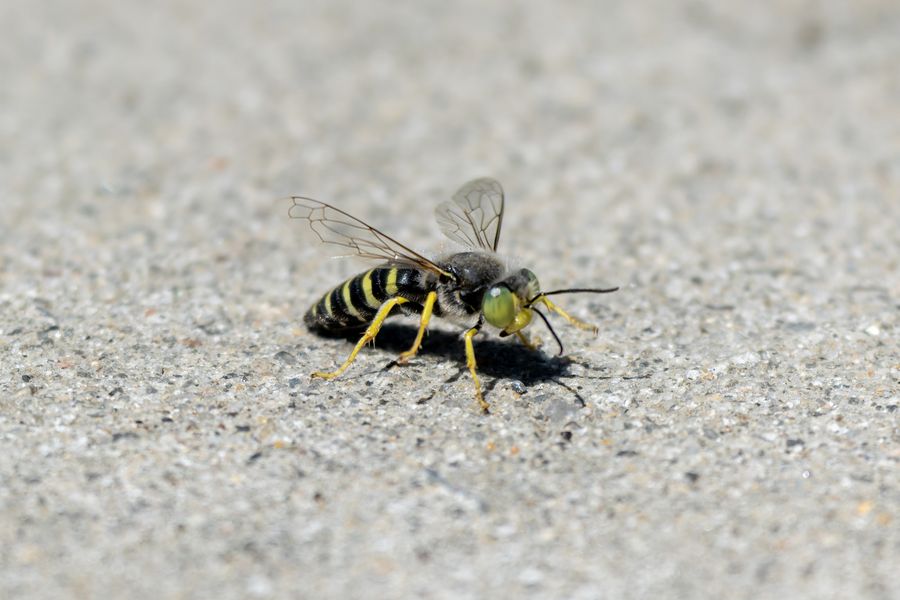
A sand wasp, Bembix, on the bare sandy ground at Arverne, which is exactly where they nest. The huge pale green eyes, the greenish-yellow bands across a stocky abdomen and the open sand all fit, and a New York beach with patches of loose sand between the vegetation is prime ground.
The females dig a burrow in loose sand and, unusually for a solitary wasp, keep bringing food to the larva as it grows rather than stocking the nest once and sealing it: flies, caught on the wing, dozens of them over a single larva's development. Which of the eastern Bembix this is would need a closer look at the face; the American sand wasp is the likeliest.
Eastern Cicada Killer
Jamaica Bay Wildlife Refuge, 3 August 2025
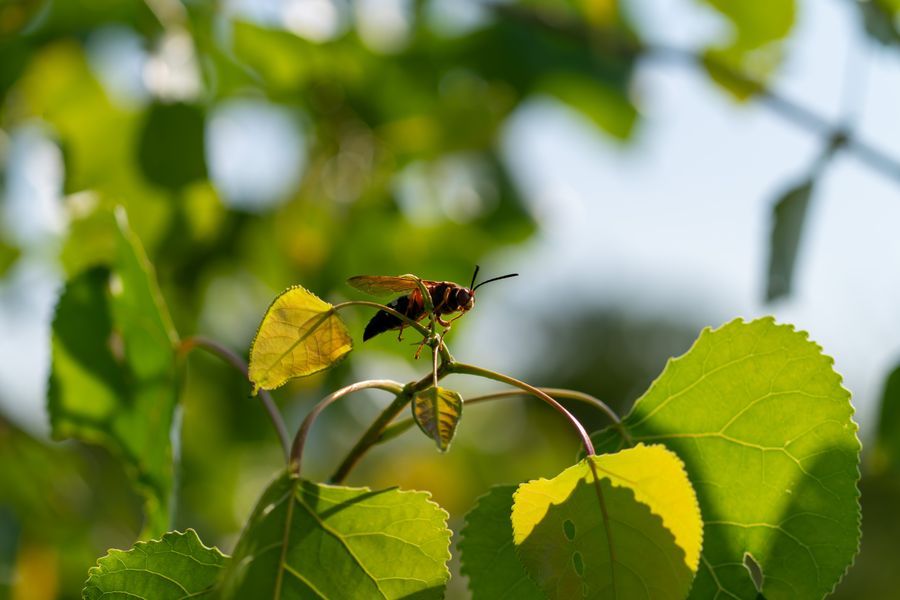
An Eastern Cicada Killer pausing on cottonwood leaves at Jamaica Bay in early August, which is its season, timed to the cicadas. Cicada killers nest in sandy ground across the eastern United States, and the bay's sand is ideal for the burrows. Not the Great Golden Digger Wasp it was first written up as.
The black abdomen with its pale yellow marks, the rust-red thorax and legs and the amber wings are the cicada killer's; a digger wasp carries orange on the front half of the abdomen, and this one has none. Among the largest wasps in the East. The female hunts annual cicadas, stings one into paralysis, and hauls it - heavier than she is - back to a burrow where it will feed a single larva. For all the size they are not interested in people, and the males, which patrol the burrows noisily, cannot sting at all.
Birds, insects, plants and other wildlife, mostly from Brooklyn, with some from further afield.
Selected
Favourite shots. Filter by subject, or .
Places
Everything, by where it was taken.
Species
Larger catalogue of photos organized by species of animal or plant, .
Catalogue
Every photograph, newest first. Narrow it by period, place or species; the three work together.
Updates
Coming soon. Sign up at the bottom of the page for updates.