Things that pretend to be bees
One bee, and six impostors
The first is a bee. Everything after it is a fly or a moth that has evolved to look like something with a sting.
Honeybee on bottlebrush buckeye
Brooklyn Botanic Garden, 12 July 2026
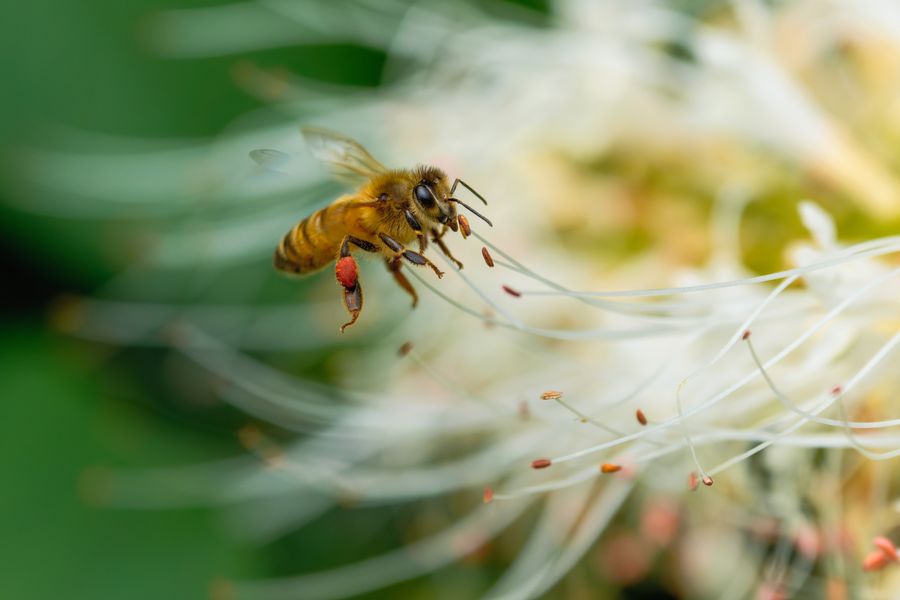
A honeybee working the long white stamens of bottlebrush buckeye in the July border, a native shrub of the south-eastern woods that flowers later in summer than most of its relatives and does it with upright candle-like spikes rather than the buckeye family's usual clusters.
The bee is already carrying a full red pollen load on one hind leg, packed down hard into the leg's own built-in basket. Buckeye pollen is red, which is how you can tell where a bee has been.
Hoverfly on great blue lobelia
Brooklyn Botanic Garden, 19 August 2026
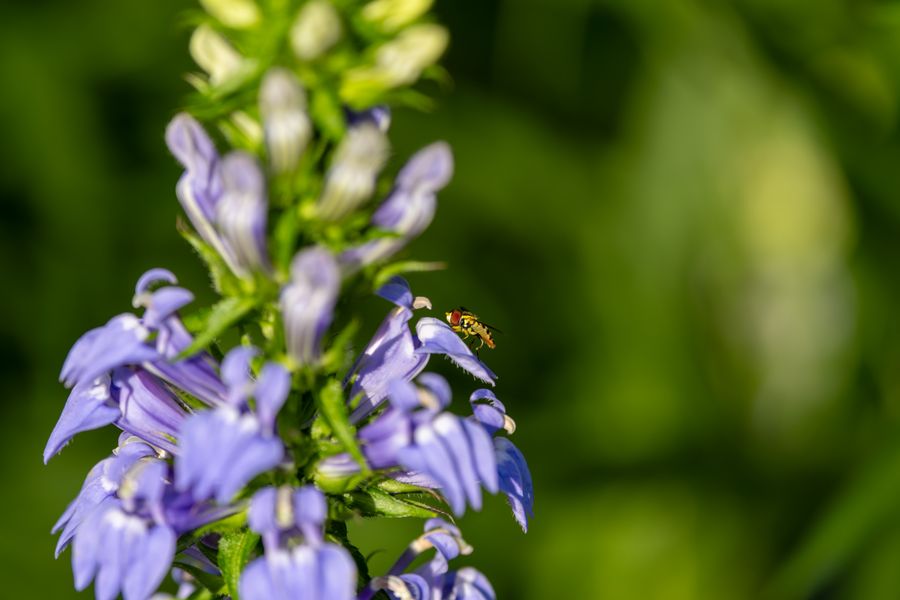
A hoverfly on great blue lobelia in the August border, a native relative of cardinal flower that swaps the hummingbird-red tube for cool blue-violet and, unlike its red cousin, is happy to be worked by bees and other short-tongued visitors. It is a plant of wet meadows across the East.
Small, with a narrow yellow-and-black abdomen: probably one of the Toxomerus flower flies, the commonest of the tiny hoverflies in the garden, wasp-patterned for protection it doesn't actually need.
Hoverfly on globe amaranth
Brooklyn Botanic Garden, 26 July 2026
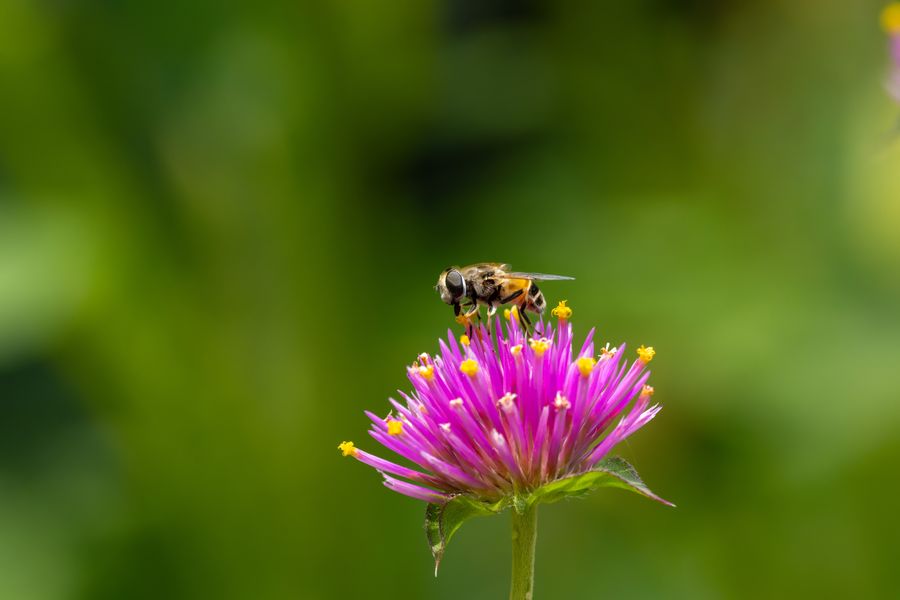
A drone fly on globe amaranth in the July border, one of the hoverflies that mimics a honeybee closely enough to fool most predators, and most people, despite having only two wings to a bee's four and no sting to back the disguise up. It is one of the commonest hoverflies in the world, in gardens on every continent.
The larvae are considerably less glamorous: aquatic "rat-tailed maggots" that breathe through a long retractable tube while living in stagnant water thick with organic matter. The ancients, finding the flies emerging from a dead ox, decided bees were born from carcasses.
Hummingbird Clearwing Moth, hovering
Brooklyn Botanic Garden, 24 August 2025
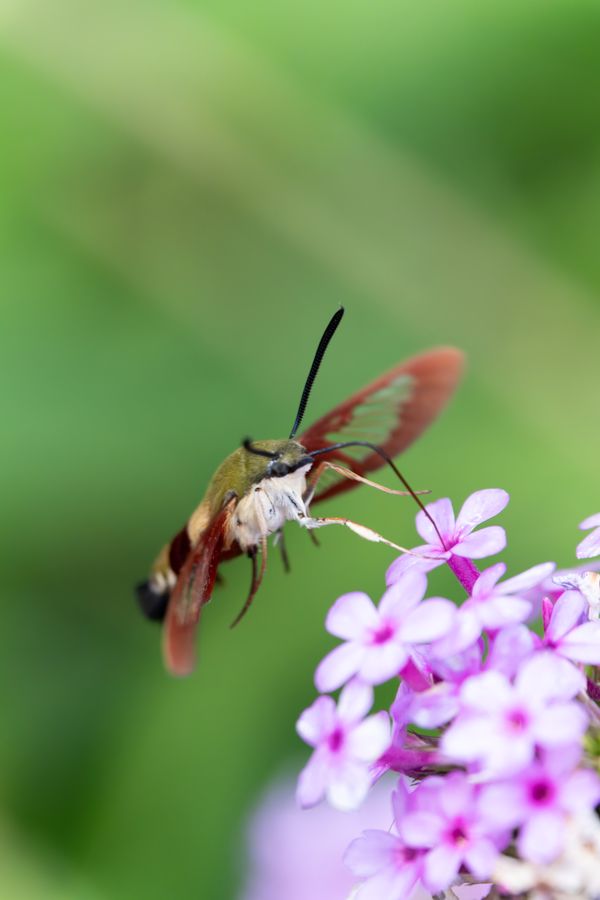
A Hummingbird Clearwing holding station in front of a flower head in the August border rather than landing on it. A day-flying hawkmoth of the eastern United States, out in full sun in gardens and at woodland edges, and mistaken for a hummingbird often enough to have been named for it.
Hovering this precise takes a wingbeat rate closer to a hummingbird's than to any other moth's, and the long tongue does the rest. The caterpillars feed on honeysuckle and viburnum.
Hummingbird Hawk-moth
Bordeaux and the surrounding area, 8 May 2026
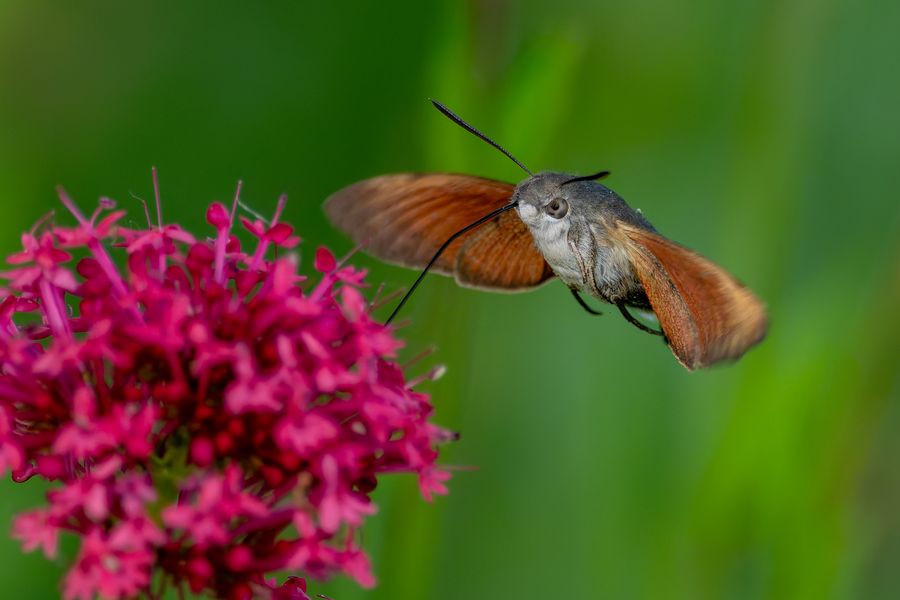
A Hummingbird Hawk-moth hovering at red valerian outside Bordeaux, the long proboscis fully uncurled and the wings a blur fast enough to genuinely mimic a hummingbird. A day-flying moth found across Europe and Asia, and a migrant, moving north from the Mediterranean each summer as far as Britain.
Unusually for a moth, it can form and hold long-term memories of which flowers in a given patch are worth returning to, and it comes back to the same valerian at the same time each day. It is also the moth most often reported to British wildlife hotlines as a hummingbird.
Bee fly
Arverne Preserve, 20 June 2026
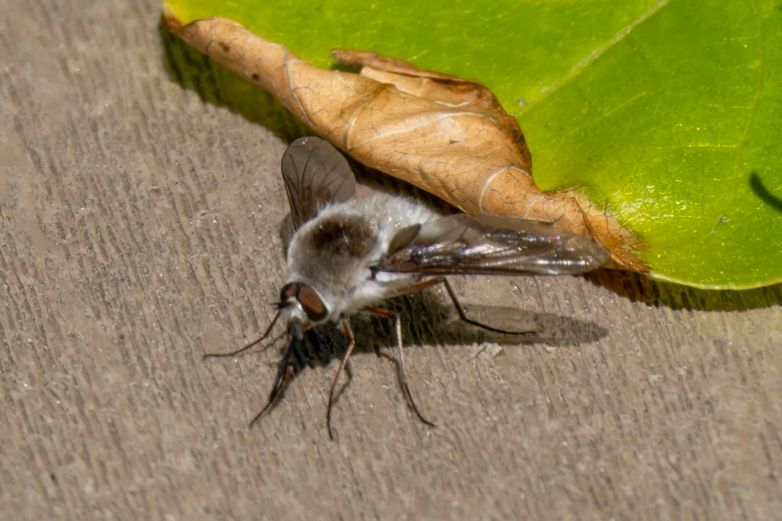
A bee fly hovering at a flower in the dune scrub at Arverne, which is where you find them: sunny, sandy ground where solitary bees nest, because the bee flies need the bees.
Bee flies mimic bees closely enough to visit the same flowers unmolested, and most species also lay their eggs near the burrows of solitary bees so their larvae can parasitise the brood inside - a double use of the disguise. The long, fixed proboscis projecting forward, used for feeding without landing, is the giveaway that this is a fly and not a bee; which of the many look-alike species is not something a photograph settles.
Tiger Bee Fly on persicaria
Brooklyn Botanic Garden, 26 July 2026
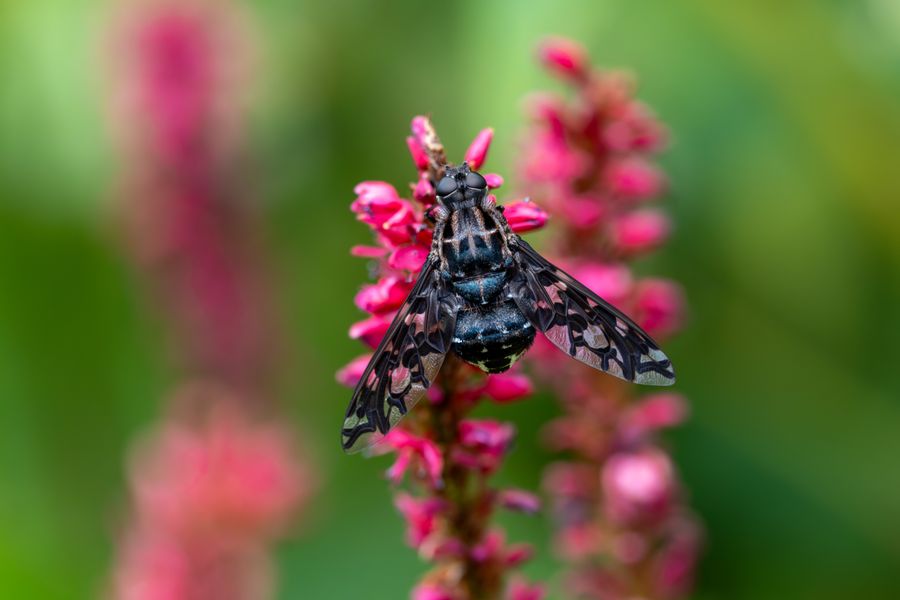
A Tiger Bee Fly on persicaria in the July border, wings spread flat and patterned almost like stained glass. It is a large bee fly of the eastern United States, and it is found near old wood and fence rails for a reason: the larvae develop as parasitoids in the nests of carpenter bees, in the tunnels the bees bore in dead timber.
The black body with its white flecks and the dark, mottled wings are distinctive enough that this is one of the few bee flies that can be named from a photograph. A flower bed full of bees and bee flies is a good deal more adversarial than it looks.
Birds, insects, plants and other wildlife, mostly from Brooklyn, with some from further afield.
Every photograph comes with notes on what it is.
Selected
Favourite shots. Filter by subject, or .
Places
Everything, by where it was taken.
Species
Larger catalogue of photos organized by species of animal or plant.
Catalogue
Every photograph, newest first. Narrow it by period, place or species; the three work together.
Updates
Coming soon. Sign up at the bottom of the page for updates.